
Architecture has always reflected the mindset of its time.In some decades, it has leaned toward monumentality. In others, toward efficiency, spectacle, or precision. But in 2026, architecture is moving in a noticeably different direction. It is becoming softer. This softness is not about weakness. It is not about a loss of rigor or a decline in architectural discipline. As someone who has spent years studying buildings, design language, and the emotional impact of space, I see this shift as a sign of maturity. Architecture is becoming softer because people no longer want spaces that simply look controlled. They want spaces that feel calm, welcoming, tactile, and deeply human. Across homes, hospitality spaces, workplaces, cultural buildings, and even retail environments, the sharpness that once defined contemporary design is slowly giving way to gentler forms, warmer material palettes, layered textures, and a stronger sensitivity to human comfort. The result is an architectural language that feels more intimate, more emotionally aware, and far better aligned with how people actually want to live in 2026. Understanding why architecture is becoming softer matters because this is not just a passing design preference, but part of wider architecture trends in 2026 What Does Softer Architecture Actually Mean? When people hear the phrase “softer architecture,” they often assume it refers only to visual style. They think of rounded corners, beige interiors, textured walls, and muted palettes. While those elements are certainly part of the conversation, softer architecture goes much deeper than surface aesthetics. Softer architecture describes a design …
Why Architecture Is Becoming Softer in 2026
March 20, 2026
95 views
12 min read
Architecture has always reflected the mindset of its time.
In some decades, it has leaned toward monumentality. In others, toward efficiency, spectacle, or precision. But in 2026, architecture is moving in a noticeably different direction. It is becoming softer.
This softness is not about weakness. It is not about a loss of rigor or a decline in architectural discipline. As someone who has spent years studying buildings, design language, and the emotional impact of space, I see this shift as a sign of maturity. Architecture is becoming softer because people no longer want spaces that simply look controlled. They want spaces that feel calm, welcoming, tactile, and deeply human.
Across homes, hospitality spaces, workplaces, cultural buildings, and even retail environments, the sharpness that once defined contemporary design is slowly giving way to gentler forms, warmer material palettes, layered textures, and a stronger sensitivity to human comfort. The result is an architectural language that feels more intimate, more emotionally aware, and far better aligned with how people actually want to live in 2026.
Understanding why architecture is becoming softer matters because this is not just a passing design preference, but part of wider architecture trends in 2026
What Does Softer Architecture Actually Mean?
When people hear the phrase “softer architecture,” they often assume it refers only to visual style. They think of rounded corners, beige interiors, textured walls, and muted palettes. While those elements are certainly part of the conversation, softer architecture goes much deeper than surface aesthetics.
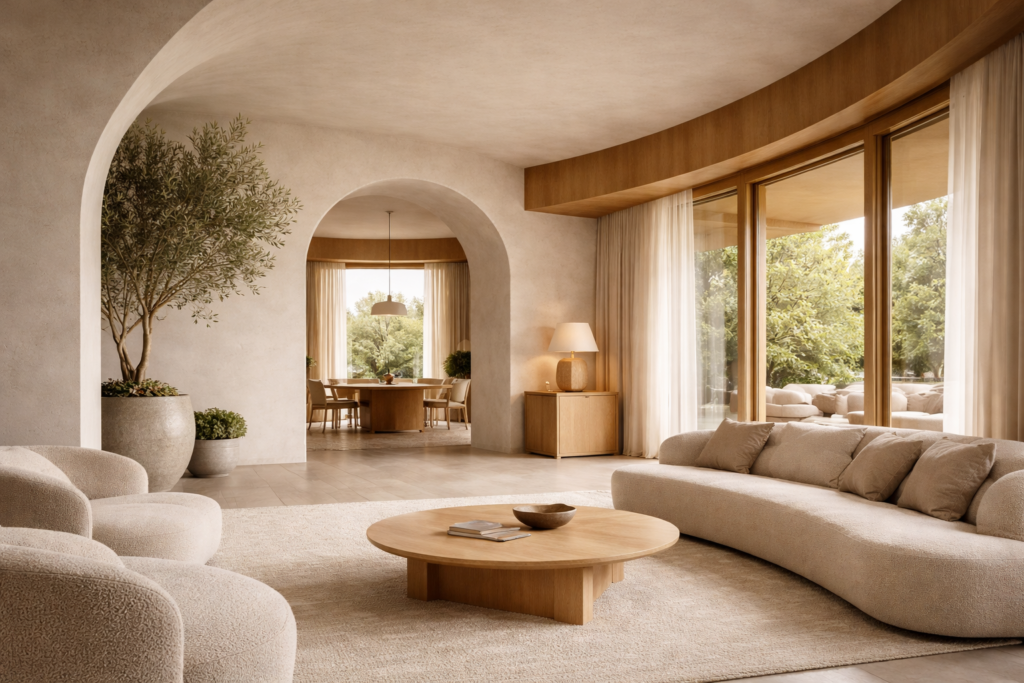
Softer architecture describes a design approach that prioritizes emotional ease, sensory comfort, and human-centered design in architecture. It is architecture that feels less severe. Less cold. Less focused on proving its intelligence through hard-edged perfection. Instead, it seeks to create environments that are more comforting to inhabit and more intuitive to experience.
This softness can be seen in formal choices such as curved walls, arched openings, sculpted volumes, and organic layouts. It can also be seen in materials like lime plaster, wood, natural stone, clay finishes, woven textures, and fabrics that feel grounded and tactile. Just as importantly, it appears in the way space is composed — through softer transitions, warmer lighting, better acoustics, gentler proportions, and a more thoughtful relationship between architecture and everyday life.
Over the years, I have come to believe that the most powerful architecture is not always the most visually aggressive. Often, the most memorable spaces are the ones that make people feel at ease without immediately announcing how much effort went into them. That quiet confidence is at the heart of softer architecture in 2026.
The Shift Away from Cold Minimalism
For a long time, minimalism dominated architectural expression. White walls, seamless surfaces, sharp detailing, exposed glass, and stripped-back interiors became symbols of refinement. At its best, that language created remarkable clarity. It celebrated restraint, precision, and discipline in a way that pushed design forward.
But over time, many of these spaces began to feel emotionally distant.
A room can be elegant and still feel empty. A building can be cleanly resolved and still feel harsh. This is where the design conversation has changed in 2026. Architecture is not abandoning minimalism altogether. It is reshaping it through warm minimalism in contemporary architecture. The restraint remains, but the emotional temperature is different.
Today’s spaces are less interested in sterile perfection and more interested in warmth. Instead of harsh contrast, they use tonal layering. Instead of glossy detachment, they introduce material depth. Instead of forcing every line to feel sharp and absolute, they allow for softness in profile, junction, and atmosphere.
This change makes sense in the world we live in now. After years of digital fatigue, overstimulation, and increasingly fast-paced lifestyles, people are drawn toward spaces that feel restorative. They want buildings that slow them down, not buildings that challenge them at every corner. Softer architecture responds to that need by creating environments that feel less like visual statements and more like places designed for real life.
Why Curved Forms Are Returning to Architecture
One of the clearest expressions of this softer architectural shift is the return of curves.
For years, rectilinear design dominated the built environment. Straight lines, hard edges, flat planes, and angular compositions became associated with modernity and control. In 2026, however, curves are returning with renewed confidence. We see them in facades, staircases, ceilings, doorways, partitions, furniture integration, and spatial planning.
This is not merely a trend-based fascination with rounded corners. Curves change the way space is perceived. They soften visual movement. They reduce tension. They make a room feel less rigid and more fluid. Even subtle curvature can transform how a person reads a building emotionally.
As an architect, I find this particularly fascinating because geometry has always shaped experience more deeply than most people realize. A sharp, rectilinear room can feel focused and disciplined, but if every corner is severe and every alignment is unforgiving, the overall atmosphere can become overly strict. Curved forms introduce a sense of release. They make architecture feel more natural, more intuitive, and often more human.
In residential design, this might appear through curved kitchen islands, rounded walls, arched passages, or sculpted niches. In larger buildings, it may emerge through flowing circulation, softened volumetric transitions, or biomorphic massing. In either case, the message is the same: architecture in 2026 is no longer afraid of gentleness.
Material Honesty Is Making Spaces Feel More Human
Another major reason architecture is becoming softer in 2026 is the growing importance of material honesty.
In earlier years, many contemporary spaces leaned heavily toward immaculate surfaces. High-gloss finishes, polished stone, pristine white planes, and engineered perfection created strong visual identities, but often at the cost of tactile depth. Today, there is a visible shift toward materials that feel natural, textured, and emotionally grounding.
Wood is playing a major role in this change. So are limewash finishes, clay plaster, brushed metal, natural fabrics, patinated stone, and handmade surfaces that reveal slight variation rather than hiding it. These materials do not just look warm. They behave warmly. They catch light differently. They age with dignity. They invite a more physical relationship with space.
That is an important distinction.
Architecture is not experienced only through vision. It is experienced through movement, touch, sound, temperature, and memory. A softer material palette reconnects architecture to the body. It reminds us that buildings are not photographs. They are places people live inside.
I have often felt that the best materials are the ones that become more beautiful as they are used, not less. Softer architecture understands this. It values materials that are alive enough to show time, texture, and atmosphere. This creates a built environment that feels less artificial and more emotionally durable.
Wellness Is Changing the Architectural Conversation
One of the biggest reasons architecture is becoming softer is that wellness is no longer treated as a luxury concept. It has become a serious design priority.
In the past, wellness was often discussed separately from architecture, as if it belonged mainly to spas, resorts, or premium residential projects. In 2026, that thinking has changed. Wellness now influences workplace design, housing, hospitality, healthcare, education, and public spaces. People are asking more from buildings. They want them to support not only function, but also mental clarity, emotional balance, and physical comfort.
This has major implications for architecture.
Once wellness becomes central, harshness becomes harder to justify. Poor acoustics, overly bright lighting, visually cold material palettes, and rigid layouts begin to feel outdated. In their place, we see architecture becoming quieter, warmer, and more carefully tuned to human response.
This tuning appears in several ways. Natural light is handled more thoughtfully. Airflow and thermal comfort become more visible design concerns. Spaces are planned to reduce friction and improve calm movement. Materials are selected not only for wellness in architecture and design appearance, but also for how they affect mood and sensory comfort.
From my perspective, this is one of the most meaningful developments in contemporary design. Architecture is beginning to understand that feeling good in a space is not a decorative luxury. It is part of what makes the architecture successful.
Biophilic Design Is Softening the Built Environment
Nature has become one of the strongest forces behind softer architecture.
This is not limited to placing a few indoor plants in a room. In 2026, biophilic design has become much more integrated and spatially intelligent. Architects are thinking more seriously about natural light, ventilation, greenery, water presence, seasonal change, and the emotional effect of bringing natural systems into daily life.
The impact of this shift is profound.
Nature softens architecture in multiple ways at once. Daylight creates visual softness as it moves and changes. Greenery softens hard surfaces and improves emotional response. Natural materials connect people to familiar textures. Outdoor views reduce the sense of enclosure. Even the sound of water or the movement of air through a space can alter how architecture is felt.
This is one of the reasons softer architecture in 2026 feels more alive. It is less sealed off. It is less self-contained. It is more willing to engage climate, light, and landscape as active parts of the design experience.
Biophilic design is especially important because it shifts architecture away from the idea of total control. Instead of creating perfectly closed environments, it creates responsive ones. That responsiveness adds richness and calm. It allows buildings to feel more connected to the rhythms of life beyond their walls.
Human-Centered Design Is Replacing Pure Spectacle
There was a time when architecture often seemed to chase imagery above all else. Dramatic forms, iconic silhouettes, and highly stylized façades dominated the cultural conversation. These projects had value, of course, but in 2026, architecture is moving toward something more grounded.
Experience is beginning to matter more than spectacle.
This shift is central to why architecture is becoming softer. Human-centered design asks different questions. It asks how a threshold feels when you enter a space. It asks whether circulation is intuitive. It asks how a room supports daily behavior, whether seating feels natural, whether scale feels comfortable, whether transitions feel calm rather than abrupt.
These are not small concerns. They are the concerns that define whether a building is actually successful for the people who use it.
When architecture becomes more human-centered, it naturally becomes softer. It moves away from visual aggression and toward spatial empathy. It pays closer attention to mood, proportion, acoustics, usability, and emotional ease. A building can still be ambitious, expressive, and intellectually rich while doing all of this. In fact, I would argue that this requires a more mature kind of ambition.
The future of architecture will likely belong not to buildings that simply impress from a distance, but to those that remain meaningful through lived experience.
Softer Architecture Is Also a Sustainability Conversation
It would be a mistake to treat softness only as an aesthetic direction. In many ways, softer architecture is closely tied to sustainability.
Buildings that prioritize natural light, passive comfort, local materials, durability, thermal balance, and long-term well-being are often softer in expression because they are responding more carefully to climate and human need. A softer building tends to be less obsessed with visual dominance and more concerned with how it performs over time.
This can be seen in the growing interest in passive strategies, adaptive reuse, locally grounded materials, and buildings that feel regionally appropriate rather than globally generic. In many cases, softness emerges from restraint. It emerges from working with the environment instead of against it.
I find this connection particularly significant because it reveals that softness is not decorative. It can actually be a sign of intelligence. A building that uses shade well, filters daylight thoughtfully, integrates tactile natural materials, and creates calm environmental conditions is not simply softer in mood. It is often more responsible in design logic as well.
That is why the softening of architecture should be taken seriously. It suggests a future where sustainability and sensory quality are no longer separate discussions. They are part of the same architectural language.
The Future of Architecture Is Becoming More Emotionally Intelligent
What we are witnessing in 2026 is not just a formal change.
It is a psychological change.
Architecture is becoming more emotionally intelligent. It is beginning to understand that a successful space is not only one that stands well or photographs well. It is also one that feels right. One that supports the nervous system. One that helps people focus, rest, gather, or reflect more comfortably.
This emotional intelligence is what ties together warm minimalism, curved forms, natural materials, wellness thinking, and biophilic design. These are not isolated trends. They are different expressions of the same deeper movement: a move toward architecture that is more humane.
After years of looking at buildings through the lens of form, style, and theory, I believe this is one of the healthiest shifts the discipline could make. Architecture should still challenge us. It should still innovate. It should still aspire toward beauty and cultural significance. But it should also understand the emotional consequences of space.
The buildings that matter most in the coming years may not be the hardest, loudest, or most severe. They may be the ones that feel gentle enough to hold everyday life with grace.
Conclusion: Why Architecture Is Becoming Softer in 2026
After studying architecture and design language for years, one thing feels increasingly clear: softness is not the opposite of strength.
In 2026, softness has become a new form of architectural intelligence.
It appears in curved geometry, warm material palettes, tactile surfaces, calm lighting, human-centered planning, and the reintroduction of nature into built space. It appears in buildings that value comfort without losing sophistication. It appears in spaces that understand that emotional ease is just as important as visual impact.
This is why architecture is becoming softer.
Not because it is retreating.
But because it is evolving.
It is learning that true refinement is not always found in sharpness. Sometimes it is found in restraint, atmosphere, texture, and care. Sometimes the most powerful architecture is not the architecture that dominates the eye, but the architecture that quietly improves life.
For designers, students, and architecture enthusiasts, this shift is worth paying attention to. Because softness is no longer just a mood. It is becoming one of the defining architectural languages of our time.
And perhaps that is exactly what 2026 needs.
Not colder spaces.
Not louder buildings.
But architecture that feels more human from the very first moment we enter it.

Kunal Shetty