


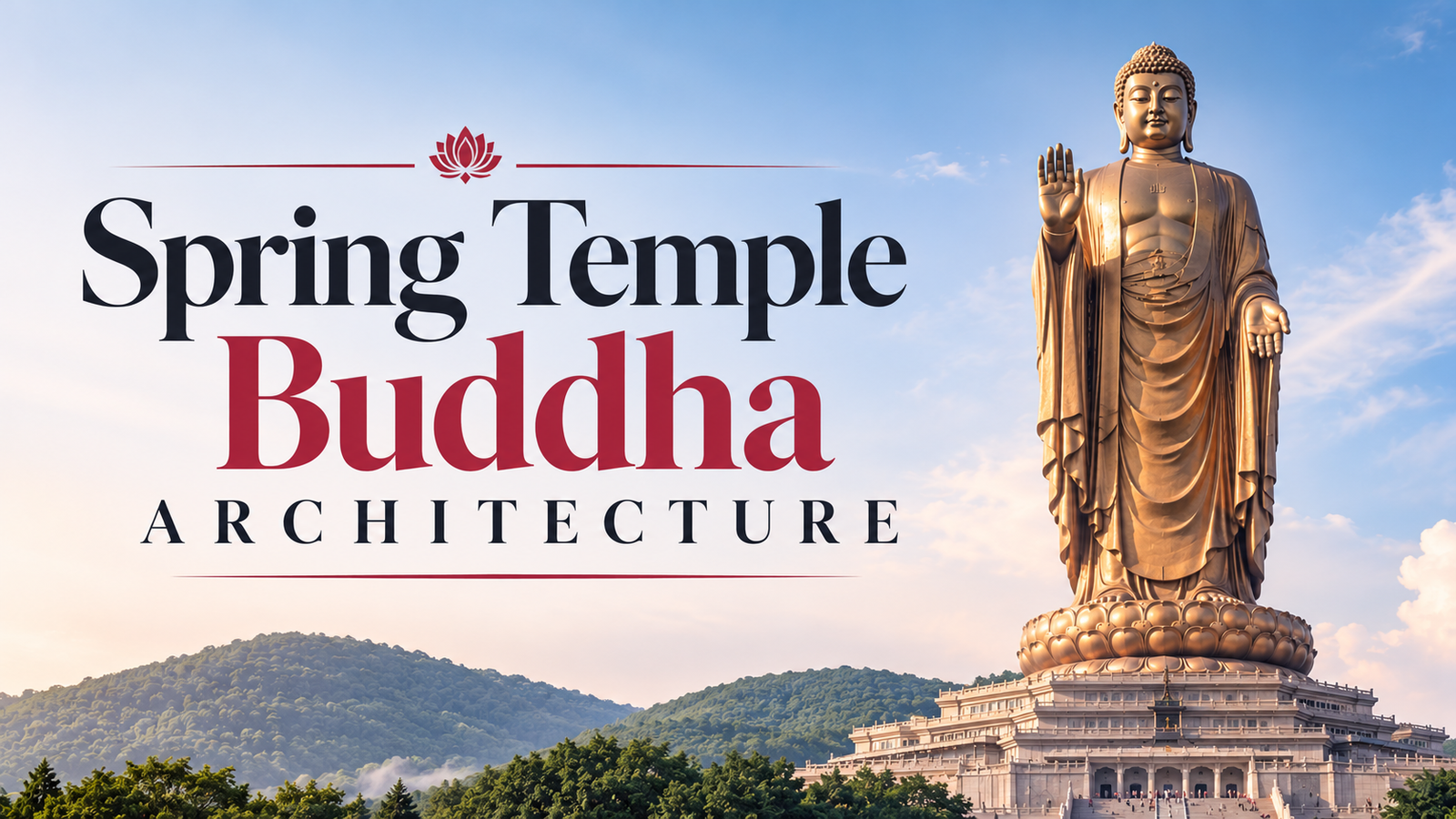
In the hills of Lushan County in China’s Henan Province, a gilded figure of Vairocana Buddha rises above the landscape. The Spring Temple Buddha stands 128 metres tall. When it was completed in 2008 it became the tallest statue in the world, a title it held until the Statue of Unity opened in India in 2018. Today it is the second tallest statue in the world and the tallest Buddha statue in the world.
The number needs some context. The 128 metres refers to the statue itself, including its lotus throne. When the pedestal building and the platforms beneath it are added, the whole monument is often given as about 208 metres. That gap is a good clue to how the project works: this giant Buddha statue in China is not only a sculpture but also a piece of monumental architecture.
This article looks at the Spring Temple Buddha as a work of architecture and engineering. It covers where it stands, why it was built, how it is made, how its structure and base work together, and what designers can learn from it, with Buddhist symbolism kept in view throughout.
What Is the Spring Temple Buddha?

The Spring Temple Buddha is a colossal statue of Vairocana Buddha, shown seated on a lotus throne. It stands within Foquan Temple, in the Fodushan Scenic Area of Lushan County, Henan. It is also known as the Zhongyuan Buddha, which means the Buddha of the Central Plains.
Work on the project is reported to have run from 1997 to 2008, with completion dated to September 2008 in most accounts. The Spring Temple Buddha statue is made of copper over a steel frame, and it is often described as a modern example of monumental sculpture in the Buddhist tradition.
It became internationally known because of its record height. For ten years, from 2008 to 2018, it was recognised as the tallest statue in the world. That record passed to the Statue of Unity, but the Spring Temple Buddha remains the tallest Buddha statue in the world.
Where Is the Spring Temple Buddha Located?
The Spring Temple Buddha location is Zhaocun township, Lushan County, in the city of Pingdingshan, Henan Province. It stands in the Fodushan Scenic Area, close to National Freeway 311, which makes an otherwise hilly and rural site reachable by road.
The surroundings are hills and valleys on the edge of the Central Plains. The statue sits on a reshaped hill, so it rises directly out of the landscape instead of standing on flat ground.
The place is linked to two older features. Foquan Temple, a Buddhist temple said to date from the Tang dynasty, stands nearby, and the Tianrui hot spring, whose water reaches about 60 °C, gave the monument its name. Together they made the site a natural choice, since it already had religious meaning and visitors.
Why Was the Spring Temple Buddha Built?
The first reason is religious. The site already had Buddhist significance through Foquan Temple, and a monument of this scale places a major Buddhist image in a landscape that already had a spiritual identity. The Buddha is meant to be seen, visited and honoured.
The second reason is regional development. The monument stands beside a hot-spring destination, and the statue and the spring support each other as attractions. Religious, cultural and tourism aims came together instead of competing.
Accounts of the project’s history often link it to the 2001 destruction of the Bamiyan Buddhas in Afghanistan, and plans were announced soon after. Many sources say site work began earlier, so that link is better read as context than as the only cause.
Who Proposed the Idea and Who Funded the Project?
Sources do not agree on one clear origin story. Accounts point to people connected with the Buddhist community of Foquan Temple and to local figures, including the monk Shi Yanfo and the businessman Li Liufa. Because primary evidence is limited, it is safer to say the idea grew from several people and groups than to credit one person alone.
On funding, Tianrui Group, the company associated with the nearby hot-spring resort, is commonly named as the main financial backer. It helps to separate the project’s religious vision, which came from the temple tradition, from its financial backing, which came largely from business.
One estimate put the whole project at about US$55 million, with about US$18 million for the statue itself. These are early estimates, and final costs may differ.
How Tall Is the Spring Temple Buddha?
The Spring Temple Buddha height is 128 metres, and that figure includes a lotus throne of about 20 metres. That leaves the Buddha figure at roughly 108 metres. Some lists give the lotus throne as 19.3 metres, which is a small difference in measurement.
The statue stands on a pedestal building about 25 metres high, which brings the monument to around 153 metres. The hill beneath was later reshaped to form two further platforms, the upper one about 15 metres tall, and with these the whole monument is commonly given as about 208 metres.
This is why you will see different heights in different sources. One counts the figure and throne, another adds the pedestal, and a third counts the whole monument from the base. The Statue of Unity in India is taller as a statue, at 182 metres, and about 240 metres including its base.
Why Did the Project Take Nearly 12 Years to Complete?
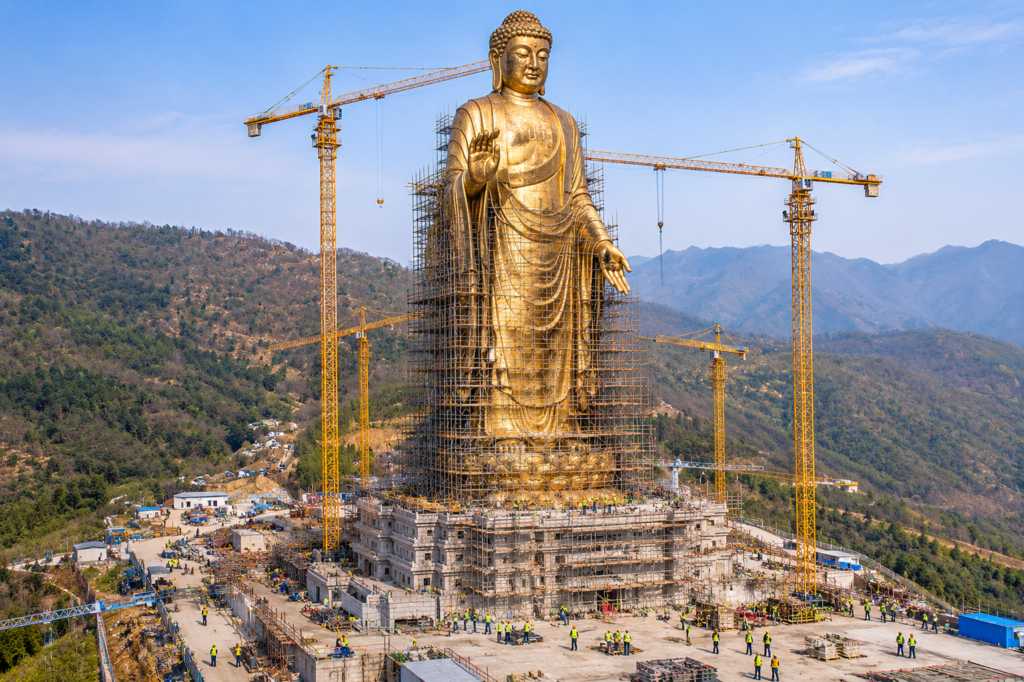
The usual dates are 1997 to 2008, which is about eleven to twelve years depending on how you count. Sources do differ on the start, and at least one site places the beginning of construction in 2001, so the exact timeline is not fully settled.
A statue like this cannot be built like a normal statue. The site had to be developed and the hill shaped, the sculpture had to be designed and scaled up, a steel frame had to be engineered, thousands of metal parts had to be made and assembled, and all of it had to happen at heights where work is slow.
Public sources do not give a detailed month-by-month schedule. What is clear is that sculpture, structure, fabrication and site works depended on one another, so a delay in one stage held up the next.
The Story Behind the Creation of the Statue
The project began as a religious idea: to honour Vairocana Buddha with an image large enough to be seen from far away. Turning that idea into a monument meant translating traditional Buddhist imagery, with its set proportions and gestures, into a modern construction method.
The form follows tradition. The Buddha sits calmly on a lotus, and a small swastika, an ancient symbol of good fortune, is inscribed on the chest. A Buddhist monastery is also reported to lie beneath the statue, which ties the sculpture to living religious use.
The challenge was that traditional sculpture is made by hand at human scale. At 128 metres, every curve of the robe and face had to be designed again as an engineered surface, so that it still looked like a Buddha from far away and still worked as a structure up close.
Who Does the Spring Temple Buddha Represent?
The statue represents Vairocana Buddha. In Mahayana Buddhism, Vairocana is associated with universal light and enlightenment, and his name is often taken to mean one who shines everywhere. He is seen as the Buddha whose light fills the whole universe.
Why Vairocana was chosen is not documented in the sources I found. A regional link is possible, since Henan is home to the Longmen Grottoes, where a large Tang dynasty Vairocana stands, but that is context and not a stated reason.
The meaning affects the design. A figure of universal light is shown gilded and calm, seated and balanced, so the image can be read as stable, open and radiant instead of dramatic. This is how Buddhist symbolism becomes part of the visual design.
Understanding the Architecture of the Statue
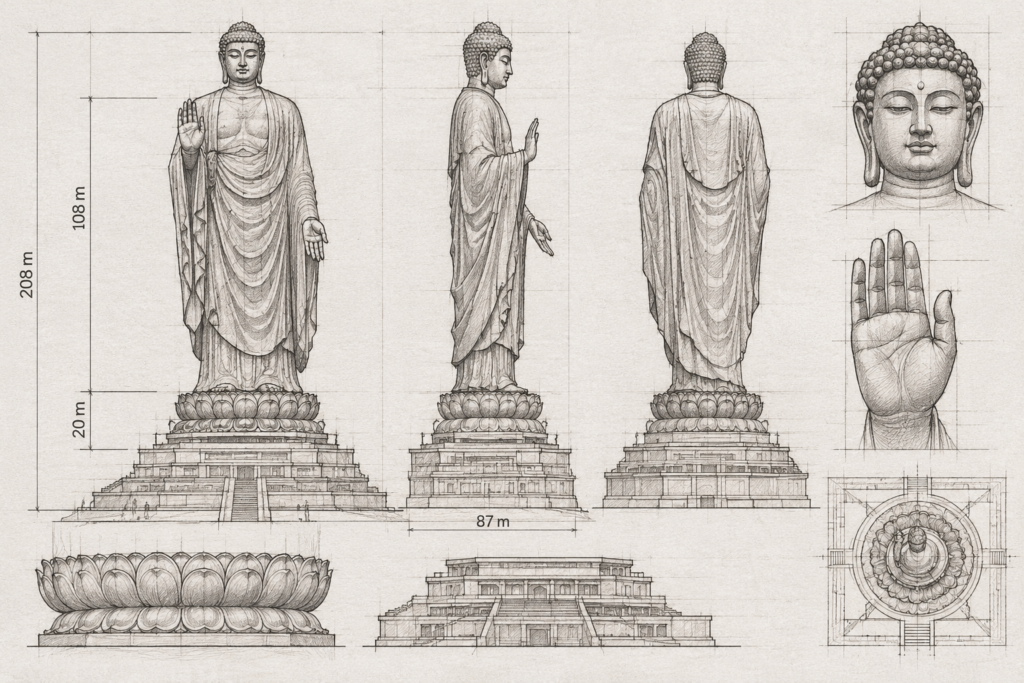
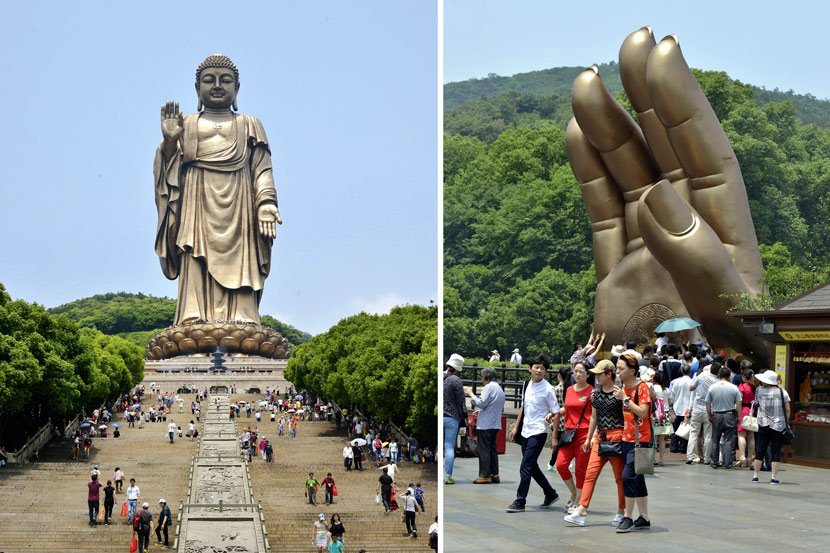
The Spring Temple Buddha architecture is a vertical sequence. At the bottom are the platforms and stepped approach, above them the pedestal building, then the lotus throne, and finally the seated figure. Each level prepares the eye for the next, so the Buddha is the end of a climb and not a single object.
The seated pose gives a wide, stable base and a low centre of gravity, which suits a very tall form. The proportions are adjusted so that the head and shoulders still read clearly from far below, where normal proportions would look squashed.
Viewers experience the monument differently at each distance. From far away it reads as one calm silhouette against the hills, from the foot of the stairs it is a mass of architecture, and from the upper platform the figure becomes a surface of plates, folds and details.
The Lotus Throne and Its Role in the Design
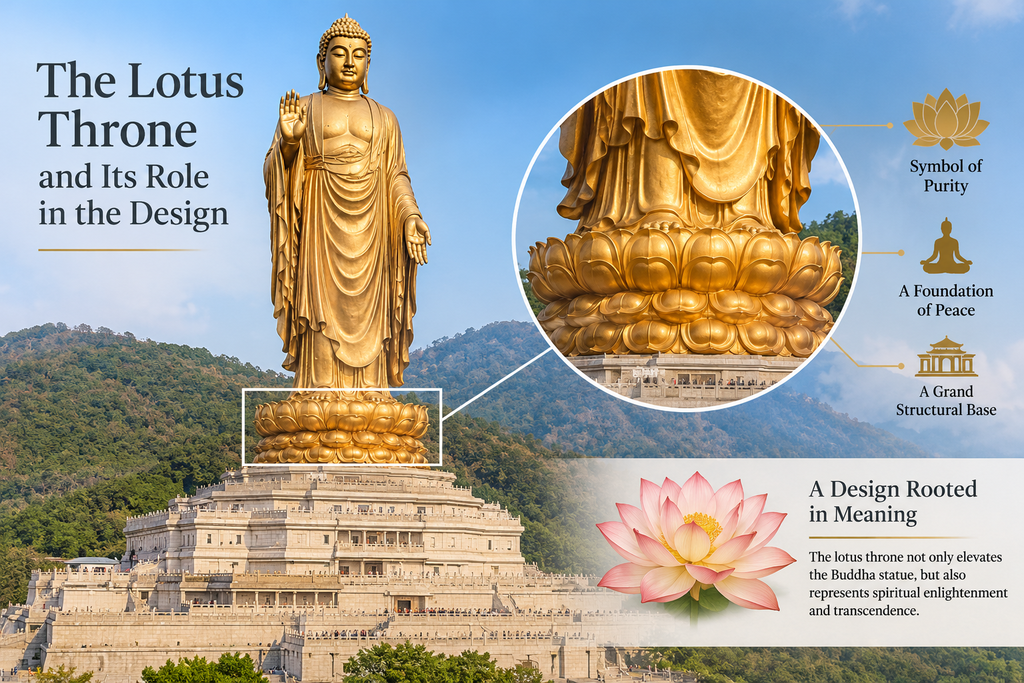
In Buddhism, the lotus stands for purity and awakening, because it grows out of mud yet opens clean above the water. A Buddha seated on a lotus is a familiar image, and here the lotus pedestal is built at a scale of about 20 metres, with pinkish-gold petals.
The throne is also a structural and visual connector. It is the transition between the figure and the architecture below, spreading the load of the statue across a wide base while giving the Buddha a soft, organic seat.
That is a good example of symbolism becoming physical design. The lotus is not decoration added later; it forms the base that carries the weight of the whole figure.
What Materials Were Used to Build the Statue?
The Spring Temple Buddha materials are a copper alloy skin over a steel frame, finished with gilding. Reported figures include about 3,300 tonnes of copper alloy, more than 15,000 tonnes of steel and a small amount of gold, with one source citing 108 kilograms. Early estimates were lower, at about 1,100 cast copper pieces and 1,000 tonnes.
The Buddha is not a solid block of metal. It is a hollow shell made of copper plates, with more than a thousand pieces welded together to form the surface, supported by an internal steel framework that carries the weight.
Copper was a practical choice for a copper sculpture of this scale. It can be cast and shaped into complex curves, it weathers into a stable surface and it can be gilded. Its durability still depends on how well the plates and joints are maintained.
How Was the Spring Temple Buddha Constructed?
Detailed construction records are not widely published, so this section follows the general process for large statues, along with the facts we do know about this one. The work starts with a sculptural model of the figure, which is scaled up in stages into a full-size design.
A steel framework is then designed and built to carry the load, and the copper skin is divided into panels that can be cast or formed, transported and fitted. At this statue, the copper pieces were welded together to form the surface.
After assembly, surfaces are finished and gilded, and the statue is checked for accuracy. Because the work is done at great height, every stage of Spring Temple Buddha construction has to be planned carefully for access and safety.
The Problems Behind the Beauty: Engineering a Giant Buddha
Detailed engineering reports for this statue are not public, but the challenges of any structure this tall are well understood. The first is weight. A statue with thousands of tonnes of metal has to send its load safely through the frame and the base into the ground.
The second is wind. Wind pressure grows with height, and a large, broad figure catches a great deal of it. The third is earthquake resistance, because a tall mass can swing and shake, and the frame and its connections must stay together under repeated movement.
Other problems are more subtle. The copper skin has to be attached to the steel without creating weak points or corrosion, the foundation has to carry very high loads, and every plate must be placed accurately so the sculpted form is not distorted across such a large scale.
Finally there is the construction itself: moving heavy parts to a hillside, lifting them and working safely at great height. For a project like this, logistics are as demanding as design.
How Was a 128-Metre Statue Made Structurally Stable?
The stability comes from the steel framework inside. It works like the skeleton of the statue, carrying the weight down through the body to the base, while the copper surface wraps around it and does not carry the main loads. This is the core of Spring Temple Buddha engineering.
The seated pose helps. A wide, low mass has a low centre of gravity, so it resists tipping better than a tall, narrow standing figure. The pedestal and platforms beneath it add width and weight at the base.
Lateral forces from wind and earthquakes must be resisted by the connections between frame members, by the stiffness of the framework and by the foundation. The visible copper skin is only a small part of the structural engineering system; most of the work is hidden inside.
The Massive Structure Beneath the Buddha
Beneath the statue are several layers of architecture. The lotus throne sits on a pedestal building about 25 metres high, which rests on a white, multi-tiered base with arched niches. Below that are two larger platforms, known as the Sumeru Seat and the Diamond Seat, reached by a wide stepped platform with a central staircase.
The hill itself was reshaped to form the upper platforms, the highest about 15 metres tall, so the base is part architecture and part landscape. A Buddhist monastery is reported to lie beneath the statue.
The base matters because it controls how visitors meet the Buddha. It lifts the figure above the trees, creates a long climb and a slow approach, and turns the statue into the top of a building instead of a standalone sculpture.
The Relationship Between the Statue and the Landscape
The monument is built into the hills, so the landscape is part of the design. The statue can be seen from far down the valleys, and its pale gilded surface stands out against the green slopes.
Because the hill was shaped to make the platforms, the base looks as if it has grown from the ground. The mountains behind give the Buddha a frame, which helps the figure feel settled and not simply placed.
Scale changes with the route. From far away the statue looks calm and contained, while on the approach the scale feels overwhelming. The natural landscape supports both experiences, and the monument works with its setting instead of fighting it.
The Buddhist Architecture Surrounding the Statue
The statue stands within the Foquan Temple complex, a Buddhist temple said to date from the Tang dynasty. The temple gives the monument a religious setting, and it is part of the wider Buddhist architecture of the area.
On Dragon Head peak stands the Bell of Good Luck, a bronze bell weighing about 116 tonnes. Bells like this are part of Buddhist temple life, and this one adds sound and ritual to the site.
There is a clear contrast between old and new. The historic temple works at human scale, while the statue is a modern intervention at monumental scale. Seeing the two together shows how a cultural landmark can hold both tradition and modern construction.
Design Details You May Miss When Looking at the Statue
At this scale, details are designed differently. A face that looks calm from far away needs bigger, simpler features than a human face, because small lines vanish at a distance. The same is true of the hands, the folds of the robe and the petals of the lotus.
Look for the small ones too. A swastika, an ancient symbol of good fortune, is inscribed inside the chest, and the lotus petals have a pinkish-gold tone. The gilded copper surface shifts in the light because the plates sit at slightly different angles.
From ground level, you rarely see the whole statue at once. Proportion, the angle of the head and the position of the hands are adjusted so that the figure still looks balanced from the places where visitors actually stand.
How the Monument Shapes the Visitor Experience
The experience begins with a distant view. The statue appears over the hills before the visitor reaches it, which builds expectation. As the route nears the site, the figure grows larger, then disappears behind the trees and appears again.
The approach involves a wide stepped platform with a central staircase, terraces and the base. Each climb reveals a new view, and the human body feels small against the Buddha’s feet. That change in scale is deliberate and part of the religious effect.
In this sense the monument is experiential architecture. The statue is not only something to look at; the route, the steps and the viewpoints guide a visitor from the ordinary world to a point of reflection.
How Is the Spring Temple Buddha Maintained Today?
Public documentation about maintenance at the Spring Temple Buddha is limited. What follows explains general practice for large monuments, and it should not be read as confirmed procedures at this site.
Typical maintenance includes regular inspection of the exterior, including plates, welds and joints, and checks on the copper surface and gilding. Engineers also monitor the structure for movement or damage, and look for corrosion where different metals meet.
Visitor areas need care too. Stairs, terraces, lighting, electrical systems, landscaping and temple buildings all need regular work. A monument that is open to the public is a working site as much as a sculpture.
How Is the Monument Protected from Natural Disasters?
Specific design reports for this statue are not public, so this section describes the main protections large monuments normally rely on. For earthquakes and wind, the main defence is a stiff steel frame, strong connections and a heavy, wide base.
Foundations are designed for very high loads and for stability on a hillside. Fire safety, lightning protection and severe-weather planning are also standard for monuments of this height, especially where visitors gather.
Crowd safety and emergency access are part of protection too. Wide stairs, clear routes and room for emergency vehicles can matter as much as structural strength when something goes wrong.
What Happens During an Emergency at a Monument of This Scale?
Details of emergency procedures at the Spring Temple Buddha are not published, so this explains how large tourist monuments usually plan. The first priority is the safe movement of visitors, using marked routes, stewards and clear communication.
Different events need different responses. A fire needs fast evacuation and access for fire crews, severe weather may require closing high areas, and an earthquake calls for moving people to open ground and checking the structure before anyone returns.
Medical response and emergency vehicle access must also be planned, since the site is on a hillside. Disaster planning for a major monument is different from planning for an ordinary building, because many people are in unfamiliar surroundings at once.
How Do Wind and Earthquake Risks Affect Monumental Architecture?
Tall structures feel stronger wind, because wind speed increases with height and a large form offers a big surface for it to push on. That creates sideways, or lateral, loads that can bend the structure and make it vibrate.
Earthquakes add seismic loads, which shake the structure from the ground up. How a monument responds depends on its mass, its stiffness and the behaviour of its materials. Steel is flexible and can absorb energy, while stiff, brittle parts may crack.
This is why engineering analysis matters. Computer models and, for very tall structures, wind tunnel tests help designers see how a form will behave before it is built. Large-scale statues and other monuments around the world rely on the same methods.
Spring Temple Buddha vs Other Giant Statues
| Monument | Statue height | Total height | Completed | Figure | Location |
|---|---|---|---|---|---|
| Spring Temple Buddha | 128 m | About 208 m | 2008 | Vairocana Buddha | Henan, China |
| Statue of Unity | 182 m | 240 m | 2018 | Sardar Vallabhbhai Patel | Gujarat, India |
| Laykyun Sekkya | 115.8 m | 129.2 m | 2008 | Gautama Buddha | Monywa, Myanmar |
| Ushiku Daibutsu | 100 m | 120 m | 1993 | Amitābha Buddha | Ibaraki, Japan |
These monuments differ in purpose. The Spring Temple Buddha and Laykyun Sekkya are religious statues of the Buddha, Ushiku Daibutsu honours Amitābha, and the Statue of Unity is a national monument. Their structures also differ: the Statue of Unity uses a concrete and steel core with bronze cladding, while the Spring Temple Buddha is a copper skin on steel.
Height alone does not define significance. The way each statue meets the ground, uses its materials and shapes the visitor’s journey tells you more about its architecture than a single number can.
What Makes the Spring Temple Buddha Architecturally Significant?
The significance lies in how many systems work together. Sculpture and engineering are combined, religious symbolism is carried into the shape, and a landscape is reshaped to become part of the monument.
The project also shows the role of materials, with copper giving a luminous, gilded skin and steel giving strength. Visitor movement, long-term maintenance and cultural purpose were all part of a monument that is public as well as religious, which makes it a work of public art and architecture.
Taken together, these ideas make the Spring Temple Buddha a useful case study of monumental architecture, even for readers who care little about records.
What Can Architects and Designers Learn from the Spring Temple Buddha?
The project offers eight practical lessons:
- Scale changes design. Details, proportions and surfaces must be redesigned for a very large size, not simply enlarged.
- Structure and art must work together. The visible form and the hidden frame have to be planned as one system.
- Material choice affects identity. The gilded copper skin is a large part of why the statue looks the way it does.
- Landscape can become part of architecture. The reshaped hill is both a base and a setting.
- Symbolism can influence spatial design. The lotus, the seated pose and the climb all carry meaning.
- Visitor movement should be considered from the beginning. Routes, steps and views shape how the monument is experienced.
- Large-scale projects require multidisciplinary collaboration. Sculptors, engineers, builders and religious advisers all have a role.
- Maintenance should be considered during design. A monument must be inspected, repaired and kept safe for decades.
Spring Temple Buddha: Key Facts at a Glance
| Detail | Information |
|---|---|
| Location | Lushan County, Henan, China |
| Buddha | Vairocana Buddha |
| Statue height | 128 m |
| Buddha figure | Approx. 108 m |
| Lotus throne | Approx. 20 m |
| Overall monument | Approx. 208 m, depending on measurement |
| Construction | Reported as 1997–2008 (sources differ on the start) |
| Main exterior material | Copper alloy, gilded |
| Structural material | Steel |
| Copper used | Approx. 3,300 tonnes in later accounts (early estimates: about 1,000 tonnes) |
| Steel used | More than 15,000 tonnes |
| Copper plates | Reported figures vary (early estimates: about 1,100 castings) |
| Nearby site | Foquan Temple |
| Natural feature | Tianrui hot spring |
These Spring Temple Buddha facts come from published accounts that do not always agree, so treat the material figures as approximate.
The Lasting Legacy of the Spring Temple Buddha
The Spring Temple Buddha shows how religion and architecture can meet at a very large scale. It takes a traditional image, Vairocana seated on a lotus, and builds it with modern steel, copper and construction methods.
It also shows what monumental sculpture can become in contemporary construction: part sculpture, part building and part landscape. Its engineering is an achievement in itself, and its cultural and tourism role has made it a lasting landmark.
That is why the monument is worth studying today. Beyond the record height, it offers lessons on structure, symbolism, materials and the experience of place that architects, designers and students can use well beyond Buddhist architecture.
Frequently Asked Question About Spring Buddha Temple
The Spring Temple Buddha is located at Foquan Temple in the Fodushan Scenic Area, Lushan County, Henan Province, China. The monument stands within a mountainous landscape near the Tianrui hot spring.
The project’s development involved Buddhist figures associated with Foquan Temple, while Li Liufa and Tianrui Group are strongly associated with its financial backing and development. Public sources do not clearly establish one person as the sole originator of the entire concept.
The Spring Temple Buddha was developed as a major Buddhist religious and cultural monument, while the wider project also supported the development of the surrounding tourism destination. Its creation brought together religious, cultural and tourism objectives.
The monument uses a substantial internal steel framework to provide structural support, while copper components form the external sculptural surface. This separation allows the structure to achieve both the required strength and the detailed appearance of the Buddha.